


What Is Speaker Efficiency?
What Is an Evacuation System?
What Is Speaker Efficiency?
What Is an Evacuation System?
Measuring speaker impedance: basics and practice
Anyone who plans, operates or maintains speakers, amplifiers or complete PA systems will sooner or later come across the topic of measuring speaker impedance. Impedance plays a central role in the functionality and safety of a sound reinforcement system. It determines whether an amplifier is loaded correctly, whether speakers operate efficiently and whether faults are avoided. In this article, we show you how to carry out impedance measurements correctly, why they are so important and which methods are suitable for different applications.
What does speaker impedance mean?
Impedance is the electrical AC resistance of a speaker. It is specified in ohms (Ω) and describes how strongly the speaker influences the flow of current at changing frequencies. Since music and speech cover a wide frequency spectrum, impedance is constantly changing. Manufacturers therefore specify a nominal value, such as 4, 8 or 16 ohms.
Correct matching between amplifier and speaker is crucial: if the impedance is too low, the amplifier is overloaded. If it is too high, the speaker cannot draw sufficient power.
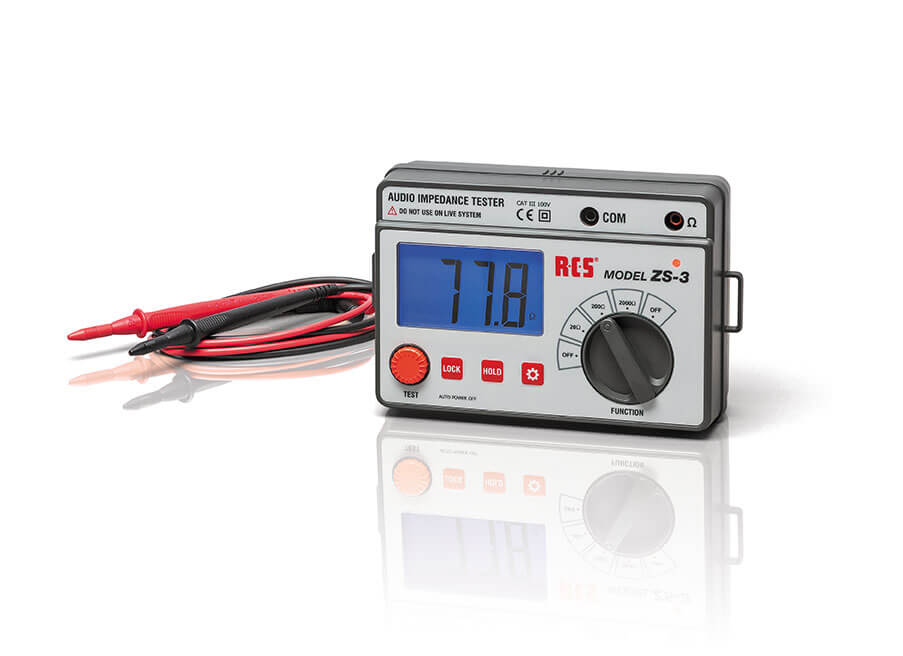
Why should impedance be measured?
A correct impedance measurement offers several advantages:
Methods for measuring speaker impedance
Depending on the application, different measurement methods are available, from simple multimeters to professional test systems.
1. Multimeter measurement
2. LCR meter
3. Professional impedance analysers
Typical errors when measuring impedance
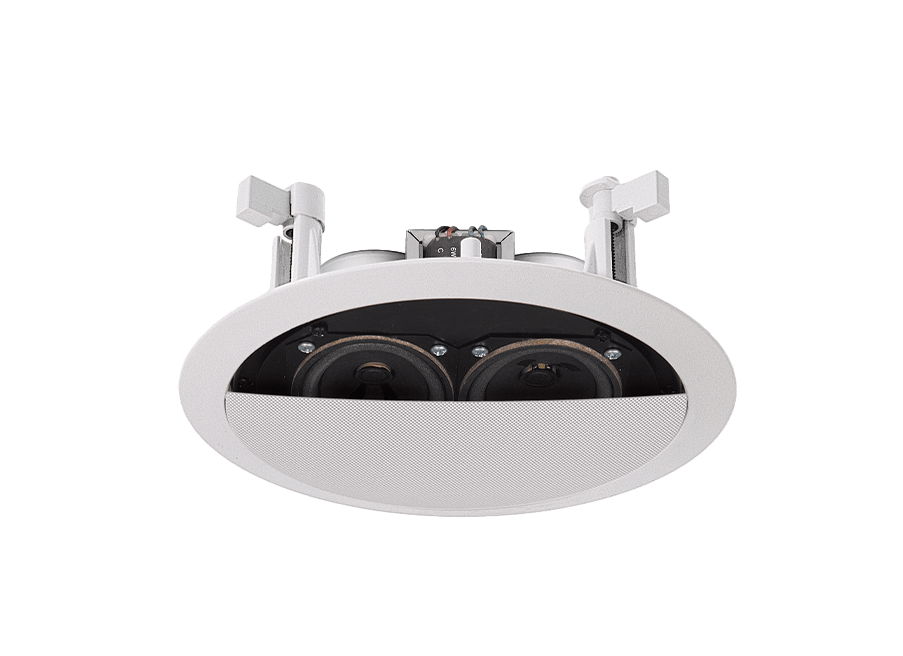
Special features of 100 V technology
In PA technology, 100 V speaker systems are used. Here, impedance measurement is particularly important because several speakers are operated in parallel. Measuring the total impedance makes it possible to determine whether the maximum load of the amplifier is being maintained. If the values are incorrect, overloads or failures during emergency operation may occur.
Conclusion
Measuring speaker impedance is a central part of the installation, maintenance and operation of sound reinforcement and voice alarm systems. Whether using a simple multimeter, an LCR meter or a professional impedance analyser, the results provide valuable information for safety, sound quality and reliability. Especially in safety-critical areas such as evacuation or lockdown alarm systems, correct impedance measurement is indispensable.